Ecco che entra nella classe blu della Scuola Materna, la Maestra d’in

glese. Porta con sé un sorriso smagliante per rallegrare i suoi piccoli allievi. Ha sempre una borsa piena di libriccini e schede per meglio intrattenere i bambini alla lezione.
Mentre si sistema davanti a loro, percepisci gli sguardi di quegli occhietti vispi che attendono di sentire parlare in una lingua diversa.
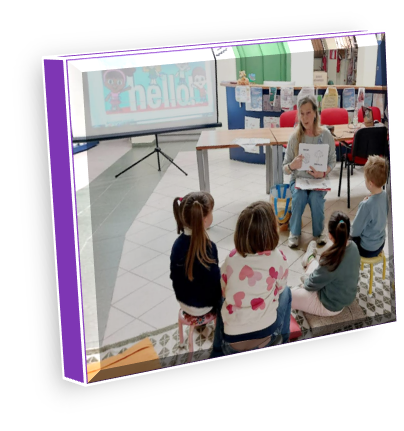
È un momento sospeso, quasi magico. La luce del mattino filtra dalle finestre, illuminando i granelli di polvere che danzano a ritmo intorno ai vivaci movimenti in classe. Non c’è il silenzio assoluto, ma quel brusio sommesso fatto di respiri, lo sfregamento delle ginocchia sul tappeto e il suono quasi impercettibile di piccole mani che, con una precisione ancora incerta, cercano di afferrare le flash-cards colorate della Teacher.

Insegnare l’inglese ai più piccoli non è mai “solo” una questione di lingua. È un atto di fiducia. Quando un bambino di tre o quattro anni modella la bocca per espellere un timido “Hello!”, non sta solo riproducendo un fonema straniero: sta allungando un ponte verso l’ignoto.

C’era un bambino, chiamiamolo Giacomo. Per settimane era rimasto ai margini della fila, osservando tutto con occhi grandi e seri, le labbra serrate come un forziere prezioso. Partecipava con lo sguardo, ma la sua voce era un segreto che non voleva rivelare.
Poi, durante una canzoncina simpatica, che indicava i giorni della settimana, Giacomo si è sporto in avanti ed ha iniziato a sussurrare insieme ai suoi compagni “Monday, Tuesday, Wednesday,…..
In quel momento, la gioia collettiva ha vinto sulla sua timidezza. Con un soffio di voce, ma con un sorriso che gli illuminava tutto il viso, ha esclamato: “the days of the week”.
Quella scena è stata una vittoria minuscola per il mondo, ma enorme per lui.
In quel momento non ha solo imparato delle parole; ha imparato che la sua voce ha il potere di influenzare la realtà, di far ridere gli altri, di farlo sentire parte di qualcosa di più grande.

Le “piccole mani” esplorano il mondo attraverso una nuova lingua, e che l’apprendimento è, alla sua base, un atto d’amore. Non stiamo riempiendo vasi vuoti, stiamo accendendo fuochi. E ogni “Red”, ogni “Jump!”, ogni abbraccio mimato in una canzone è una scintilla di gioia pura.
È in questi istanti che capiamo che non stiamo solo insegnando l’inglese: stiamo aiutando degli esseri umani a diventare la versione più aperta, curiosa e felice di se stessi.
Le lezioni del progetto “SINGING AND PLAYING” sono state ripetute nella biblioteca comunale. I bambini, in questa sede erano accompagnati dai genitori. Si notavano i loro sguardi fieri nel far sentire a Mamma e Babbo i progressi ottenuto in classe, e sorridevano al loro meritato applauso.
Per la Maestra il premio più grande resta l’affetto dimostrato dai piccini quando la incrociano per strada, e con un misto di timidezza ed emozionati dicono,
“Mamma quella è la Maestra d’Inglese”.
TRANSLATION:
Here enters the English Teacher in the blue classroom of the kindergarten. She brings a warm smile to cheer up her little students, and always with a big bag full of little books and flashcards to better entertain the children during lesson.
As she settles in front of them, she gazes at those bright little eyes waiting to hear a different language.
It’s a suspended, almost magical moment. The morning light filters through the windows, illuminating the specks of dust dancing in rhythm around the lively movements in the classroom. There’s no absolute silence, but that soft murmur of breathing, the scraping of knees on the carpet, and the almost imperceptible sound of little hands, with uncertain precision, grasping the teacher’s colorful flashcards.

Teaching English to little ones is never “just” a question of language. It’s an act of trust. When a three- or four-year-old shapes his mouth to expel a shy “Hello!”, he is not just reproducing a foreign phoneme: he is extending a bridge to the unknown.
There was a little boy, let’s call him Giacomo. For weeks, he had stood at the edge of the line, observing everything with wide, serious eyes, his lips pursed like a precious treasure chest. He participated with his gaze, but his voice was a secre he didn’t want to reveal.
Then, during a cute little song about the days of the week, Giacomo leaned forward and began whispering with his classmates, “Monday, Tuesday, Wednesday,…!”
At that moment, the collective joy overcame his shyness. With a whisper of a voice, but with a smile that lit up his entire face, he exclaimed: “the days of the week.”
That scene was a tiny victory for the world, but a huge one for him.
In that moment, he didn’t just learn a verb; he learned that his voice has the power to influence reality, to make others laugh, to make him feel part of something bigger.
The “little hands” explore the world through a new language, and that learning is, at its core, an act of love. We’re not filling empty vessels, we’re lighting fires. And every “Red,” every “Jump!”, every hug mimed in a song is a spark of pure joy.
It’s in these moments that we understand that we’re not just teaching English: we’re helping human beings become the most open, curious, and happiest versions of themselves.
The “SINGING AND PLAYING” project lessons were repeated in the municipal library, where the children were accompanied by their parents. Their proud expressions were evident as they shared their progress with Mum and Dad, and they smiled at their well-deserved applause.
For the teacher, the greatest reward remains the affection shown by the little ones when they pass her on the street, and with a mixture of shyness and excitement they say,
“Mum, that’s the English teacher.